| |
The greenhouse effect explained
through classical physics, quantum physics
and spectroscopy
and
likely temperature variation to come
By the Scientific Committee of Terre & Climat
TM, Mars 2026, v.08.4
www.laquestionclimatique.org
.
Abstract - The
greenhouse effect, primarily caused by water vapor
and carbon dioxide CO2
in the atmosphere, remains sensitive to future
increases in CO2.
The increase in CO2
over the past 150 years appears to have already
raised the Earth's surface temperature by 1.3°C.
Nevertheless, even if human activities continue to
increase for several decades, this effect of CO2
is projected to remain below 2.5°C by 2100. At this
level, it could even prove beneficial to life on
Earth.
| |
SUMMARY
Terrestrial Radiation
Energy Levels of Molecules and Spectra
Collisions, Excitation, and De-excitation in Air
Spontaneous vs. Induced Emission
Average Earth Temperature
Influence of Greenhouse Gases (GHGs)
Role of H₂O and CO₂ on Temperature
Conclusion |
|
Terrestrial
radiation
The Earth receives energetic short-wavelength
radiation from the sun (ultraviolet, visible, and
short-wave infrared) and radiates long-wavelength
infrared radiation back into space through the
atmosphere.
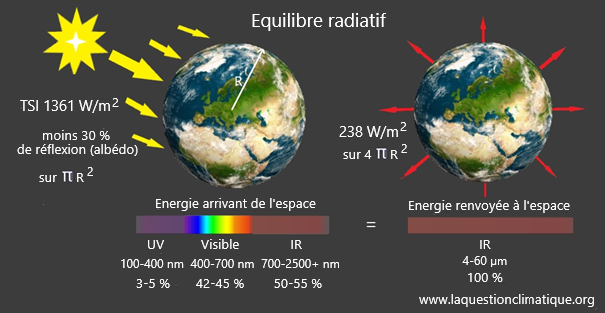
The total solar irradiance (TSI) is 1361 W/m² over a
receiving surface area of the Earth's disk equal
to
πR².
Albedo, meaning various reflections (including
clouds, icy surfaces, etc.), reduces the Earth's
radiation by 29-30%. Thus, the Earth receives
238-239 W/m² at the top of its atmosphere, relative
to its total spherical surface area of 4πR².
A portion of this radiation is itself absorbed by
the atmosphere (clouds, ozone, dust, etc.), and only
about 165 W/m² reaches ground level, contributing to
the planet's heating.
To maintain its thermal balance in space and its
stable temperature, the Earth must reflect back as
much energy as it receives, i.e. at the top of the
atmosphere, about 238 W/m2 relative to its entire
surface of 510,100 billion m2.
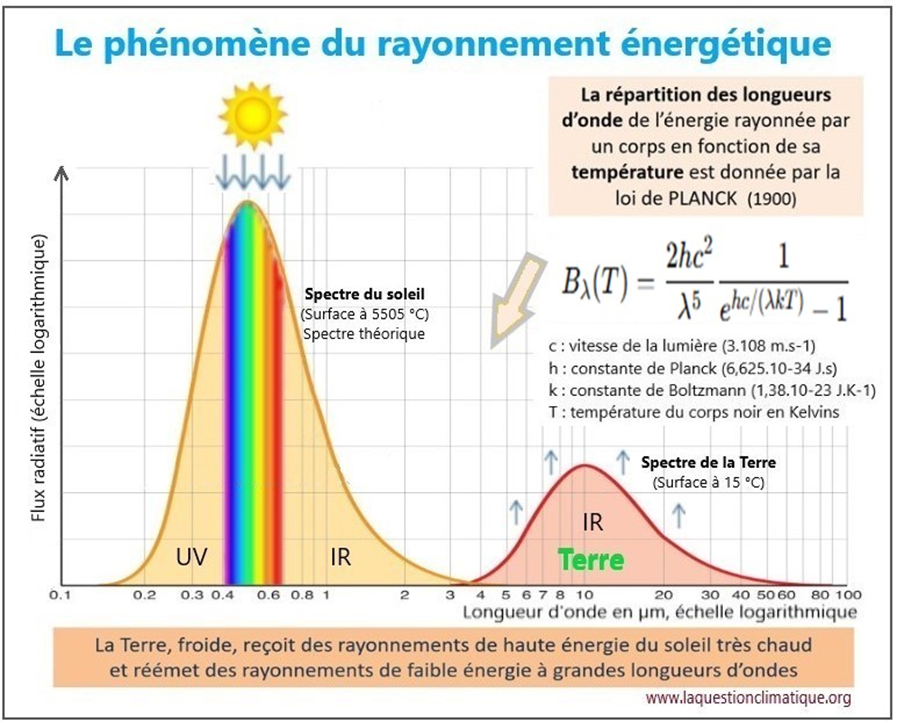
The Earth, which has a continuous "blackbody" radiative
spectrum with an emissivity
ε
close to
1
(ε ≈ 0,96),
maintains its thermal equilibrium by radiating day and
night.
The laws that quantify
energetic radiative phenomena are:
1) Planck's law for the distribution of wavelengths (see
diagram).
2) Stefan-Boltzmann law for the energy radiated in watts
(E =
εσT⁴),
where
σ
is the Boltzmann constant.
Based on its average global temperature of 288 K (15°C),
the Earth emits an irradiance at ground level of
≈390 W/m² (Stefan-Boltzmann Law. Power
emitted by far-infrared radiation, considering an
emissivity ε of 1).
Only 238–239 W/m² reach space due to radiative
mechanisms related to the greenhouse effect.
Energy levels of molecules and spectra
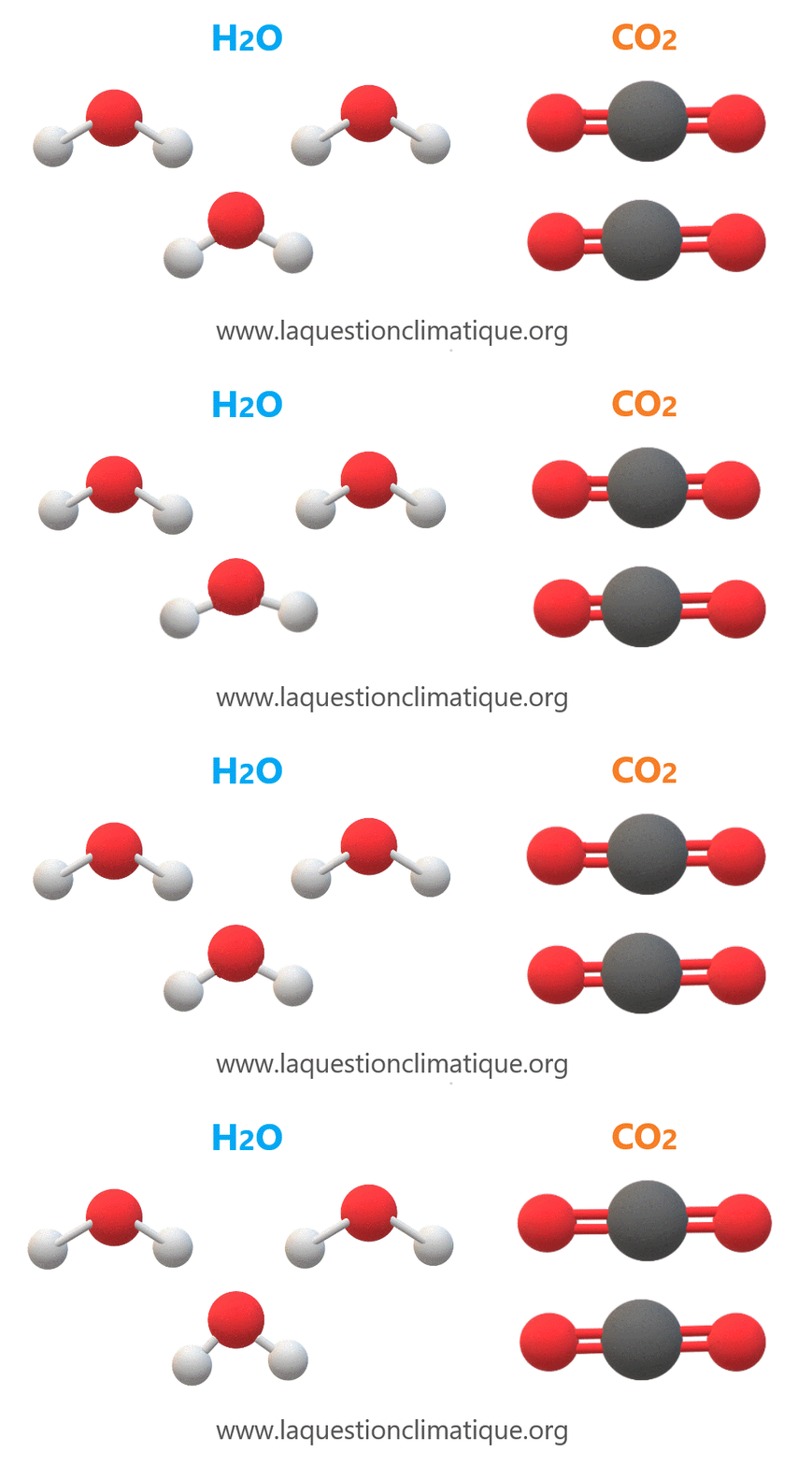
Heteronuclear molecules present in the atmosphere, such
as CO2,
H2O,
N2O,
CH4,
CFC-12, etc., absorb or emit long-wavelength infrared
radiation because they possess a dipole moment that
allows for vibrations (elongation, torsion) and
rotations.
Animation here
CO2
and H2O
are dominant in terms of their influence on the
greenhouse effect.
CO2
has four vibrational modes and two rotational modes;
H2O
has three vibrational modes and three rotational
modes. Homonuclear molecules of oxygen O2
or nitrogen N2
do not possess such properties and are transparent
to infrared radiation.
Examples of vibrations
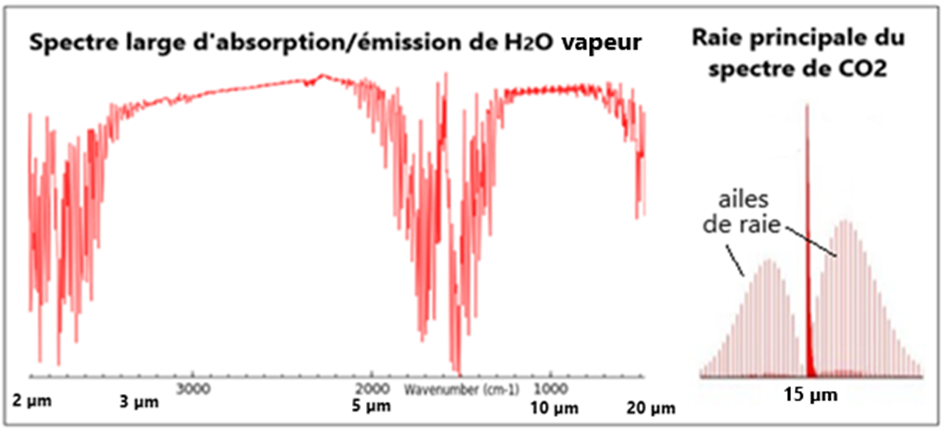
For CO2, the mixing of
the ω1 frequency torsion mode with the ω2 symmetric
stretching mode produces a condition known as the Fermi
resonance, which significantly broadens (to 13-17 µm)
the spectrum of the wings of the 15 µm main line. This
leads CO2 to be very
spectroscopically active, even though the main line is
rapidly saturated at 15 µm.
These properties of molecules allow them to interfere
with long-wavelength infrared radiation emitted by the
Earth's surface. The molecules absorb or re-emit
infrared radiation, which changes their energy level.
They are then at a reduced or increased energy level
depending on whether they are de-excited or excited. At
its lower energy level, a molecule can absorb a quantum
of infrared radiation (=photon); at its higher, excited
energy level, it is capable of emitting a photon.
Infrared radiation capable of interfering must have
wavelengths compatible with the rotational and
vibrational characteristics of the molecules. This leads
to specific spectra.
These spectra consist of thousands of quantum lines of
different frequencies that have been measured and are
established in the universal basis.
HITRAN.
| |
Contrary to what is sometimes
claimed, atmospheric absorption of CO2 is far from being "saturated."
It is true that infrared radiation at the exact
frequency ω1 of the carbon dioxide torsion mode
is already completely absorbed after just a few
hundred meters, but this statement is false for
frequencies located in the wings of the broad CO2 absorption spectrum. In fact, the
radiative forcing associated with CO2 varies proportionally to the
logarithm of its concentration in the
atmosphere. One reason for this remarkable law
is the triangular shape of the absorption
spectrum around the torsion mode frequency.
Thus, increasing the concentration simply
increases its effect by an amount proportional
to the logarithmic ln. |
|
The infrared spectra of greenhouse gases, the most
extensive of which is that of water vapor, cover almost
the entire blackbody infrared emission spectrum of the
Earth, except for an "atmospheric window" between 3-5
and 8-13 µm, which is transparent to infrared.
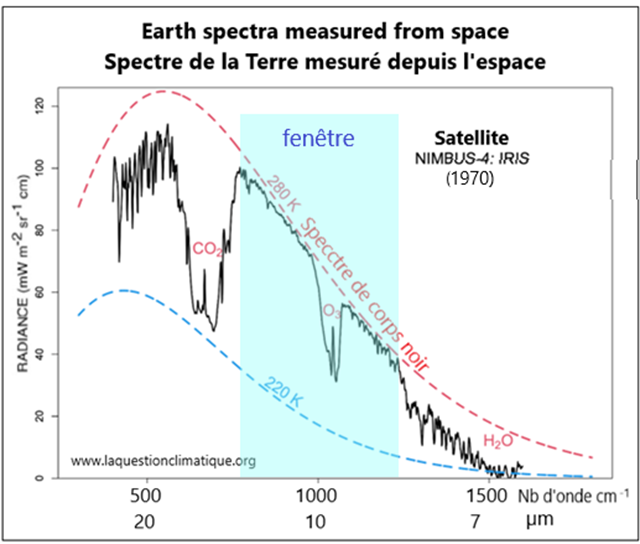
It should be noted that the absorption and emission
capacities of active molecules are linked to temperature
(see Planck, in
T⁴)
and that they undergo line broadening depending on
various effects: concentration, pressure, Doppler
effect, collisions, line mixing, hot bands, Voigt line
shape, Fermi resonance (CO2),
rotational band structure, etc.
Expansion of the ray's wings of CO 2
with its concentration
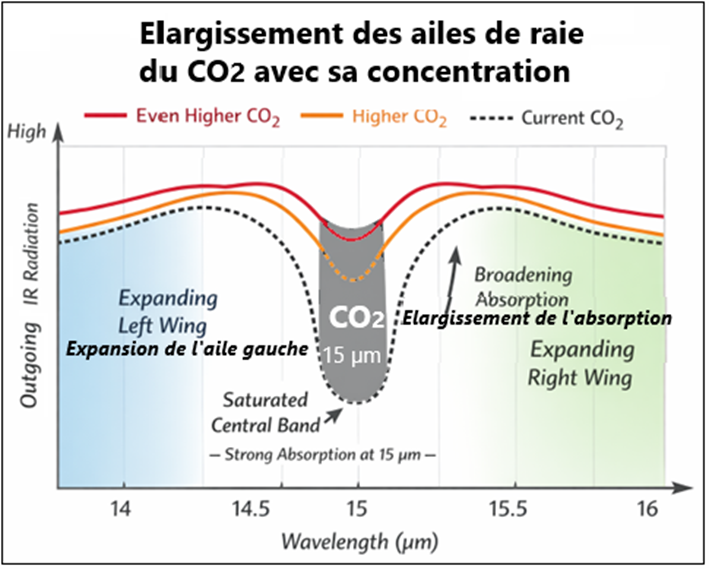
The Earth radiates directly
into space at a rate of approximately 40-50 W/m², which
is a significant proportion. The 8-13 µm window is
indeed close to the maximum intensity of the Earth's
emission spectrum, which ranges from 4 to 50 µm, and the
absorption spectrum of H2O
is weak between 8 and 13 µm. In contrast, the CO2
lines are even closer to the maximum of the Earth's
spectrum (Wien Maximum).
Collisions, excitement and de-excitement in the air
According to gas kinetics, collisions between greenhouse
gas (GHG) molecules (CO2,
H2O, CH4,
etc.) and air molecules (O2,
N2, Ar) are far more
numerous and frequent than spontaneous infrared
emissions from GHG molecules in their excited state,
which bring them to a de-excited state.
A common misconception is to conclude that GHGs are thus
de-excited and therefore cannot spontaneously emit
infrared (IR) radiation. But conversely, appropriate collisions
also bring unexcited GHG molecules to a higher (excited)
energy level.
=> Therefore, collisions excite or de-excite, and
maintain and control, a statistical population of a few
percent of GHGs in an excited state (see Boltzmann
distribution).
This equates to approximately 3 to 4% in an
excited state for CO2
at 288 K (15°C) and 1 atmosphere of pressure.
This rate is significantly lower for water vapor but its
concentration is ≈50 times higher.
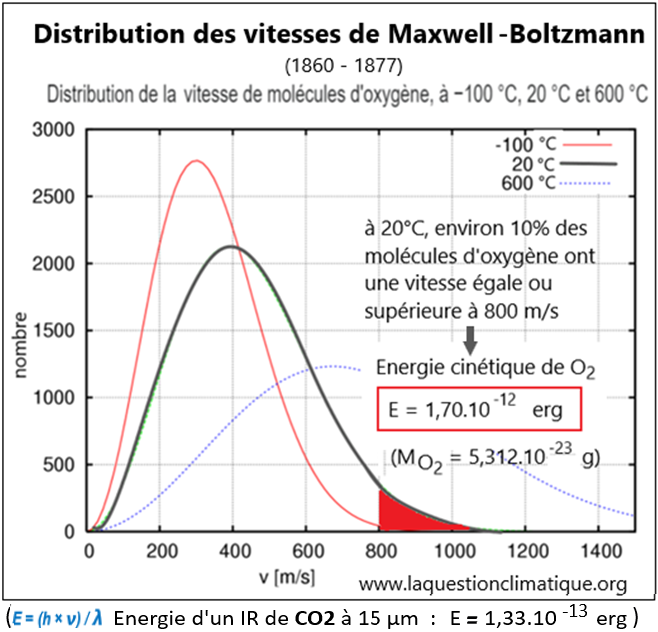
For a molecule, the orders of magnitude are :
~4 × 10⁹ collisions per second
~3 × 10⁸ energetic collisions per second
~10⁶ effective vibrational excitations per second
~10 to 10² spontaneous radiative emissions per second
Spontaneous multidirectional infrared (IR) emissions
within the atmosphere do occur, although they are
proportionally rare. However, the number of molecules
per cubic meter is enormous. This translates into
spontaneous IR fluxes of hundreds of W/m² (relative to
the Earth's surface) throughout the entire atmospheric
column. These emissions, which have the specific
spectrum of the greenhouse gas in question, depend on
the kinetic temperature of the gas (value in °K, see
Planck).
| |
Note: Collisions of O2
and N2
create an instantaneous dipole. This dipole
allows interaction with radiation—but with a
lifetime of approximately 10⁻¹² s and a low
probability—resulting in a very diffuse
spectral intensity, hence a very broad
emission, but on the order of 0.2 to 0.3
W/m², which is very low compared to the 240
W/m² of the OLR into space.
With only O2
and N2,
the atmosphere would be transparent to
terrestrial infrared radiation. |
|
Spontaneous emission and
induced emission
For excited molecules, that is, those at a higher
energy level,
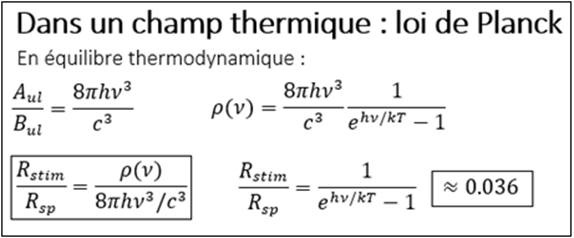
Einstein's relation A ul
= (8πhν³/c³) x Bul
(h Planck constant; c speed of light)
links spontaneous emission Aul
and induced emission Bul
(emission induced, stimulated by an incident photon).
This relation dictates the ratio Aul/Bul
for a given wavelength.
| |
|
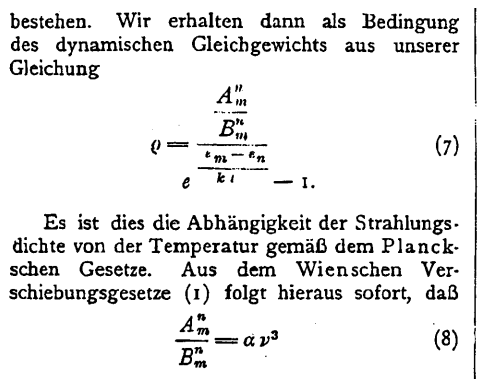
Einstein
wrote in his article "On the Quantum
Theory of Radiation" (1917):
(Translated
from German)
“Recently, I found a derivation of the
Planck radiation formula
that is
based on the fundamental assumption of quantum
theory and is related to Wien’s original
considerations; in this derivation, the
relationship between the Maxwell distribution
and the blackbody chromatic distribution plays a
role. This derivation is interesting not only
because it is simple, but especially because it
seems to clarify somewhat the currently
unexplained phenomena of emission and absorption
of radiation by matter. I have shown, based on
some assumptions about the emission and
absorption of radiation by molecules, which are
closely related to quantum theory, that
molecules distributed in temperature equilibrium
on states consistent with quantum theory are in
dynamic equilibrium with Planck radiation. In
this way, I deduced the Planck formula in a
remarkably simple and general manner.” This was
a consequence of the condition that the
distribution of molecules across their internal
energy states, required by quantum theory, must
be established solely through the absorption and
emission of radiation“
 |
|
|
At
the spectroscopic density ρ(ν),
which is related to wavelength and temperature (see
Planck), spontaneous multidirectional emission of CO2,
for example, is approximately 28 times
greater than induced emission (ratio 0.036). The same
principles apply to water vapor and methane.
In a thermal field: Planck's law
in thermodynamic equilibrium
And since greenhouse gas (GHG) molecules are present in
a small percentage in the excited state, directional
stimulated emissions are negligible. Thus, the
directionality of radiation emanating from the Earth's
surface has no impact.
Note – In the radio wavelength
(microwave) range, directional stimulated emissions
dominate; this is the regime of masers. This is also the
regime of lasers when external amplification is applied.
In the visible spectrum, spontaneous isotropic emission
is overwhelmingly dominant.
Average Earth Temperature
The Earth's average temperature is conventionally
defined as the air temperature near the surface,
measured approximately
≈2
meters above the ground.
(The actual ground temperature—in the Sahara or in the
ice caps—can differ considerably.)
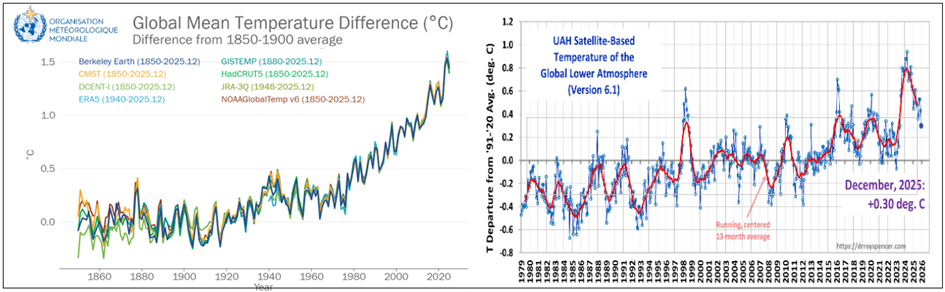
According to ground-based data from the
WMO (World Meteorological Organization), the
average global surface temperature in 2025 exceeded the
1850–1900 average by 1.44°C ± 0.13°C.
Satellite measurements appear to
indicate a slightly lower value. From 1980 to 2025,
WMO observations project a temperature
increase of 0.8–0.9°C, while
satellite observations suggest a smaller increase of 0.6–0.7°C.
* It should be noted
that temporary temperature disturbances are linked
to the periodic effects of ENSO (El Niño), which
recurs more or less regularly every two to seven
years. Other modest, unexplained variations can be
attributed to unknown natural causes. Thus, an
apparent period of temperature stability occurred
from 1945 to 1975 and then from 1995 to 2015. These
temporary influences have an amplitude of less than
0.5 °C and disrupt an otherwise regular background
progression. It is possible that temperature
moderations could be partly attributed to
fluctuations in solar irradiance. According to
several studies, solar influence has been minimal in
modern times, and even slightly less so in recent
decades (Fedorov, 2013). As for the minima of the
11-year solar cycle (e.g., cycle 24; 2008-2019),
they decrease the TSI by approximately 1.3 W, and
the amplitude of the temperature fluctuation is
about 0.2 °C.
This study does not take into account these various
small and ephemeral fluctuations.
Influence of Greenhouse Gases (GHG)
The Earth's infrared
radiation flux into space, initially exhibiting
a blackbody spectrum, is slowed down by the
atmospheric thickness of greenhouse gases
(except in the 8-13 µm window). Unexcited
greenhouse gas molecules progressively intercept
this flux according to their spectra.
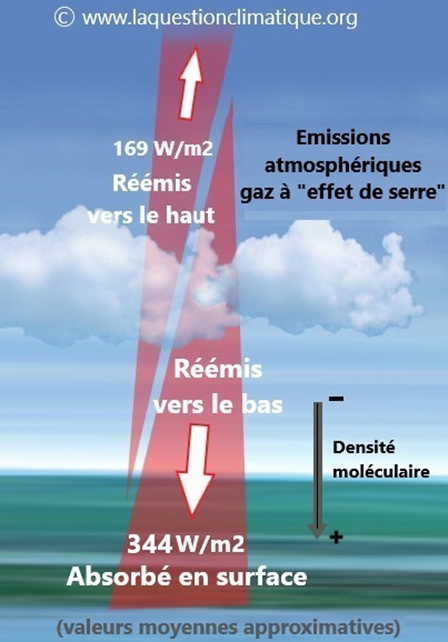
Subsequently, spontaneous emissions re-emit
infrared radiation with greenhouse gas spectra
towards space (238-240 W/m² minus the window)
and towards the surface (344 W/m² back
radiation). The back radiation spectrum is
analyzed by
AERI
interferometry.
We measured the increase in this emission
towards the surface with the increase in global
temperature.
It is on average +0.02
W/m²/year
attributed to CO2.
Back radiation (DLR - Downwelling Longwave
Radiation) is more significant due to higher
molecular density and temperature near the
surface than at altitude, as well as the action
of denser water vapor in the first few
kilometers, further enhanced by the influence of
low clouds (stratus, stratocumulus). |
|
 |
Cette accumulation temporaire d’énergie en retour sur
terre est absorbée (sols, océans) et provoque un moindre
refroidissement de la surface qui est assimilé à un
réchauffement par effet de serre.
Surface energy balance
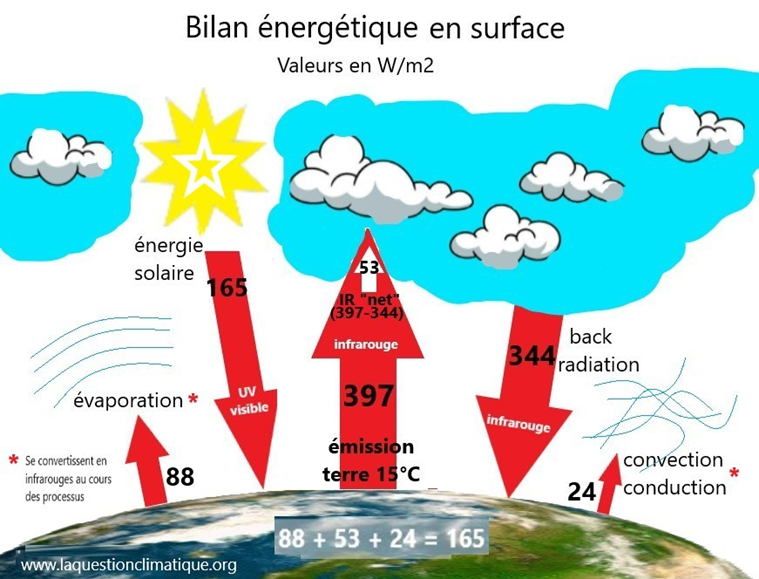
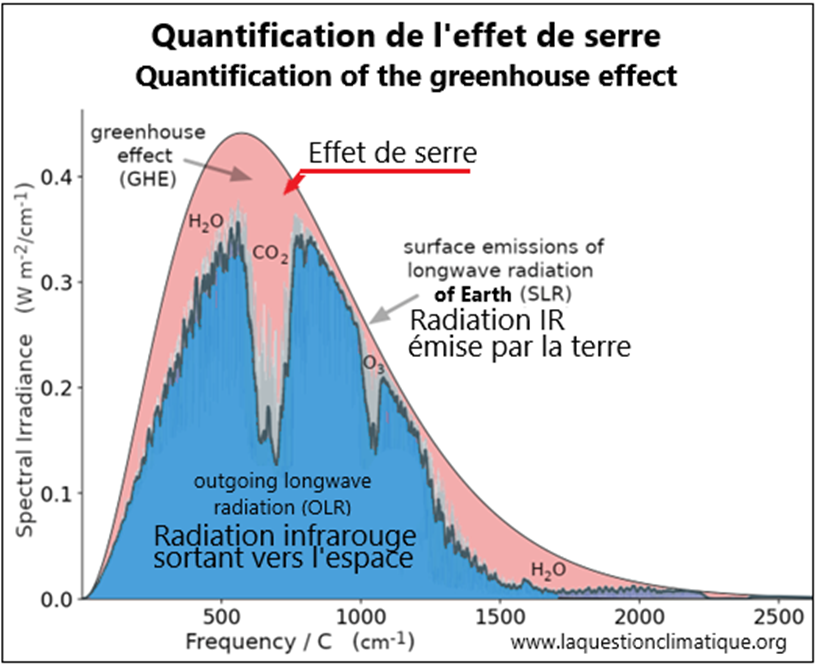
The Earth's radiated IR flux
captured in the atmosphere is approximately:
By water vapor: ≈60%
By CO2:
≈20%
By clouds + other sources: ≈20%
However, CO2 is
crucial because, particularly at high altitudes,
it controls the background temperature, which
in turn controls water vapor.
The actual spectrum seen from space by satellite
observations
(e.g.
NASA instruments)
typically shows:
Zone spectrale
Altitude d’émission
Window 8-13 µm Earth
surface (blackbody continuous spectrum fraction)
CO2
wings
~ 3-5 km (13 à 17 µm)
CO2
center
~ 11 km (15 µm)
H2O
bands
~ 2-6 km (broad)
Terrestrial radiation exerts a direct and immediate
influence on air temperature through the kinetic energy
imparted by excited greenhouse gases, particularly at
low altitudes, which contributes to convection. At
equilibrium, absorptions are balanced by emissions
within an elementary air cell, which must maintain the
local thermodynamic equilibrium (LTE) imposed by gas
kinetics and collisions.
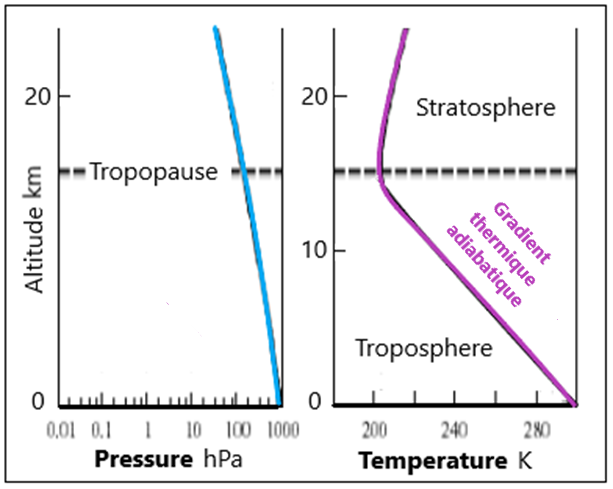
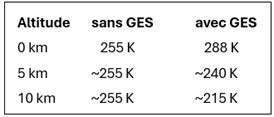
In the absence of greenhouse gases (GHGs), radiative
emissions into space would originate from sea level. In
the presence of GHGs, which absorb radiation over
several kilometers before re-emitting, these emissions
occur at a virtual average altitude equivalent to
approximately 5-6 km, where the temperature is -18°C
(see Goody & Yung 1952-1989 and modern satellites). This
results in a temperature difference of approximately
33°C compared to the surface (the "greenhouse effect").
 |
|
Pressure gradient :
Earth's gravity attracts and retains atmospheric
gas molecules, but their thermal agitation (gas
kinetics) tends to propel them into space. This
creates a pressure gradient between 1 atm at
ground level and approximately 0 atm at several
tens of kilometers altitude (1/100,000 atm at 80
km). However, no molecule reaches Earth's escape
velocity of 11.2 km/s, which would allow them to
escape Earth's atmosphere, thus maintaining its
permanence. It should be noted that Earth's
gravity does not act proportionally; the
acceleration due to Earth's gravity, which is
9.81 m/s² at ground level, is still 9.78 m/s² at
10 km altitude. |
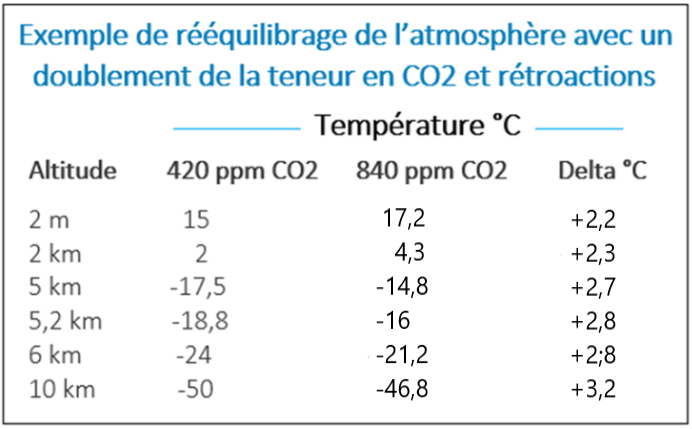
An increase in greenhouse gases (GHGs) will naturally
increase the atmospheric absorption thickness, specific
to each GHG, and thus raise the emission altitude by
several tens or hundreds of meters. To maintain
equilibrium irradiance and irradiate 239 W/m² at the new
altitude, the atmosphere must warm globally and
compensate for the emission temperature throughout the
entire atmospheric column, down to the ground, to
achieve a sufficient temperature at the new emission
altitude.
This does not occur through the direct action of back
radiation (344 W/m²) towards the surface -which
nevertheless represents the greenhouse effect- but
rather through the atmospheric temperature gradient
(-6.5°C/km for the temperature gradient in a standard
humid atmosphere). Without water vapor, the dry
temperature gradient would be -9.8°C/km.
The entire atmosphere re-equilibrates itself through the
thermal gradient to compensate for the 33°C difference.
* Surface temperature depends directly on the altitude
of emission.
The thermal gradient adjusts its value within a
few days or weeks through the homogenizing movements of
the atmosphere: advection (horizontal), convection
(vertical), and any turbulence, which mixes water vapor
and gases emitted at the surface.
Example of atmospheric rebalancing
Role of H2O
and CO2
on température
Variation of irradiance towards space
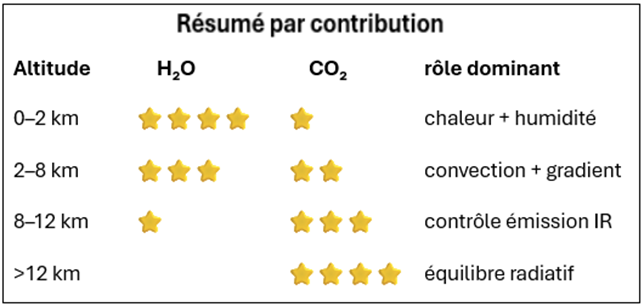
In the lower troposphere (lower atmosphere), the effect
of water vapor, with its broad spectrum and high
concentration, dominates the greenhouse effect. In the
upper troposphere, where water vapor becomes less
abundant through condensation, CO2
plays a crucial role. Its main 15 µm spectral line is
quickly saturated, but the spectral ray wings remain
unsaturated and are subject to broadening effects
(Doppler effect, concentration, collisions, Fermi
resonance, etc.).
Therefore, the concentration of CO2
has a significant impact on the overall atmospheric
temperature.
Decrease in irradiance towards space due to increased
CO2:
Radiative forcing in
W/m²
: ∆F = 5.35 ln (C/C0)
C = current CO2
concentration, C0 =
initial CO2
concentration
A doubling of the CO2
concentration thus results in an irradiance ∆ of -3.7
W/m²
at the OLR.
The numerical coefficient 5.35 W/m² is derived
from spectroscopic calculations, notably those
carried out by Gunnar Myhre et al. (1998), James
Hansen, etc.
These values are remarkably robust and
independent of global climate models. The
coefficient of 5.35 is based on line-by-line
molecular spectroscopy (HITRAN, etc.) and is
confirmed by satellite measurements and observed
atmospheric profiles.Satellites (IRIS,
IMG,
AIRS,
IASI)
show a progressive decrease in the outgoing flux
between the 1970s and today, specifically in the
15 µm CO2
band and in certain CH4
and N2O
bands, with no equivalent decrease elsewhere.
This is an unambiguous spectral signature.
Effect of CO2
on temperature
| |
Let's hypothesize
about the evolution between the end of the 19th
century and 2026 with the change in CO2
concentration from 280 ppm to 420 ppm. The
difference in irradiance at the OLR is certainly
5.35 ln(420/280) = 2.17 W/m². This corresponds
to +1.3°C at the surface if we attribute over
150 years the entire temperature variation
measured to the effect of CO2. |
|
Simple studies support this
hypothesis : natural effects offset ; oceanic absorption.
The observed cooling of the stratosphere rules out a
solar influence.
One difficulty lies in determining the climate
sensitivity coefficient, most often denoted λ (lambda),
which is defined as the factor relating a radiative
forcing ΔF (expressed in W·m⁻²) to a variation in the
global mean surface temperature ΔT (in K or °C),
according to the linearized relationship: ΔT = λ · ΔF.
This coefficient must indeed incorporate feedbacks
(water vapor, clouds, etc.).
For an average surface temperature of approximately 288
K, the derivative of the emitted infrared flux with
respect to temperature leads to a typical value: α₀ ≈
3.2 to 3.3 W·m⁻²·K⁻¹, which corresponds to a climate
sensitivity without feedback: λ₀
≈ 0.30 K·(W·m⁻²)⁻¹.
This value of 0.30 thus
constitutes an absolute lower bound for climate
sensitivity (Hansen, 1984), (Pierrehumbert, 2010).
No realistic assumption about clouds, atmospheric
circulation, or the ocean can eliminate this constraint,
as it is incompressible and imposed by thermodynamics
and radiation. It is sometimes called
« Planck's
minimum ».
However, feedback loops come into play, notably the
additive effect of increased water vapor due to
higher surface evaporation caused by rising
temperatures (Clausius-Clapeyron equation; +1°C =>
+7% potential evaporation – this is nevertheless a
maximum that is not automatic nor reached in all
regions).
It should be noted that increased surface
evaporation significantly cools soils and ocean
surfaces (by 88 W/m²) but not directly the lower
atmosphere, since the energy extracted is latent
energy, meaning it will only be released at higher
altitudes by water vapor upon condensation. The
lower atmosphere can only be directly cooled by
conduction, which is very weak, and convection near
the surface, which represents no more than 24 W/m²,
or 5% of the energy involved. Direct cooling would
only be achieved through spraying into the air; this
is what fine rain does in a way. Therefore,
radiative mechanisms are of paramount importance.
There is also a feedback loop due to clouds. This is
the least understood and is what creates significant
uncertainty regarding the value of climate
sensitivity λ. This leads, for example, to large
discrepancies in IPCC projections depending on the
assumptions used.
From the previous hypothesis (see box)
2.17 W/m²
=> +1.3°C, we deduce here a value of λ ≈ 0.60 K·(W·m⁻²)⁻¹.
Therefore, the
variation in irradiance would need to be multiplied by
0.60 to obtain the variation in surface temperature.
This is a maximum that excludes any significant and
lasting natural cause (which temporary events like El
Niño or the eruption of Mount Hong Konga are not).
This value of 0.60 for λ is very close to that obtained
by the
RRTM simulator.
Future temperature ; projections
With CO2
emissions maintained at 2.2 ppm/year in the atmosphere
(30-year average) and reaching 425 ppm in 2026, we would
obtain:
Maximum probable variations since 1900, without any
reduction in CO2 emissions
(Attributing the doubling
of λ0;
from 0.3 to λ = 0.6 to feedbacks, without a natural
cause)
1900 :
~280 ppm
=> 0,00
W/m2
=>
+0,00 °C
2026 :
~425 ppm
=>
2,23 W/m2
=>
+1,33 °C
already acquired
2050
:
~480 ppm
=>
2,88 W/m2
=>
+1,73 °C
2100
:
~590 ppm
=>
3,98 W/m2
=>
+ 2,39 °C
2150 :
~700 ppm
=>
4,90 W/m2
=>
+ 2,94 °C
2200 :
~810 ppm
=>
5,68 W/m2
=>
+ 3,40 °C
The IPCC (Intergovernmental
Panel on Climate Change), which has both political and
scientific objectives, is considerably more pessimistic.
In its latest report, AR6, 2021-2023, the projections of
average global warming compared to 1850-1900 are:
With significant reductions in CO 2
emissions ("Net Zero," etc.):
Around 2050: +1.2 to +2.0 °C;
Around 2100: +1.0 to +1.8 °C
With very high CO2 emissions:
Around 2050: +1.9 to +5.0 °C;
Around 2100: +3.3 to +5.7 °C
Conclusion
According to our reasonable
hypothesis, based on the actual trends observed so far…
…the impending climate catastrophe predicted…
…by the IPCC, in its
summary for policymaker (F) and relayed without the
slightest caution by most media outlets.
Of course, any future projection carries a risk, but
this appears low based on a century and a half of
acquired data rather than theoretical models.
Cloud influence is the least controllable parameter,
since their abundance affects the decrease or increase
of albedo, which in turn modifies the incoming solar
radiation.
The described evolution remains plausible given that CO 2
emissions will very likely continue in the short term.
We shouldn't be overly optimistic about the speed and
intensity of future emission reductions on a global
scale. And the rapid, economically ruinous reductions of
a few small countries, such as France (0.9% of global
emissions), will not reverse the overall trend.
The future
temperature in France
should not pose any fundamental new problems for its
inhabitants. Moreover, a slight increase in overall
temperature even seems beneficial,
without the need to fear more
natural
disasters. Furthermore, the increase in CO2
promotes
the greening of the earth (NASA).
 If CO2 emission reductions begin to be felt beyond
2075, particularly with the development of various
generations of totally decarbonized nuclear energy,
the Earth's climate will not have to undergo major
upheaval... until the severe cooling due to the next
Milankovitch cycle that humanity will then have to
face.
If CO2 emission reductions begin to be felt beyond
2075, particularly with the development of various
generations of totally decarbonized nuclear energy,
the Earth's climate will not have to undergo major
upheaval... until the severe cooling due to the next
Milankovitch cycle that humanity will then have to
face.
| |
SYNTHESIS
The vertical temperature structure of the
atmosphere, from the surface, emerges as a
dynamic state of equilibrium between radiative
flux, convection, and gravitational stability.
The pressure gradient, which depends on the
effect of gravity on the atmospheric mass,
remains unchanged.
H₂O
carries out a massive upward transport of energy
by convection: it stores energy by evaporation
at the surface and releases it at altitude by
condensation. It directly heats the troposphere
and extends its thickness.
CO₂
determines the altitude at which the atmosphere
"sees space," and therefore where energy must
escape. The Earth does not radiate from the
ground but from an effective altitude (~5–6 km)
σT⁴
= F; therefore, CO₂ shifts the
"effective equivalent radiative zone" upward.
H₂O
vapor → organizes the vertical transport of
energy (~70% of the gradient)
CO₂
→ determines the emission height into space
(~30% of radiative control)
|
|

|
|