|
Climate Sensitivity and CO₂
Radiative Forcing and Fundamental Physical Constraints
By the
"Earth and Climate" Scientific Committee,
January 16, 2026, v1.3
Abstract
Climate sensitivity relates an imposed radiative forcing
on the climate system to the resulting change in global
mean surface temperature. Although often presented as
highly uncertain, this quantity is in fact strongly
constrained by radiative physics, the global energy
balance, and observations. This article presents a
rigorous derivation of the climate sensitivity parameter λ, analyzes the radiative forcing of CO₂, examines the
spectral saturation argument, and demonstrates that a
minimum warming of approximately 1.1 °C per doubling of
CO₂ constitutes an irreducible physical constraint.
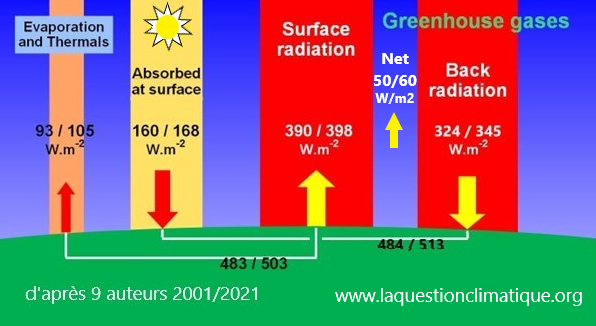
Earth’s Radiative Energy Budget
1.
General definition of climate sensitivity
The
climate sensitivity coefficient, most commonly denoted
λ
(lambda), is defined as the factor relating a
radiative forcing
ΔF
(expressed in W·m⁻²) to a change in global mean
surface temperature
ΔF (in K or °C), according to the linearized relation :
ΔT
= λ
· ΔF
This
relation is a valid approximation for moderate radiative
perturbations around the mean climatic state and forms
the basis of the quantitative analysis of climate
change.
The
determination of
λ
is not direct:
it results from a combination of radiative physics,
internal climate feedbacks, and observational
constraints. It is therefore essential to distinguish
strictly physical contributions from uncertainties
associated with the dynamics of the climate system. 2.
Global energy balance of the climate system
Earth’s climate is governed by a global energy
balance between absorbed solar radiation and outgoing
infrared radiation to space (≈ 238 W·m⁻²). At the top of
the atmosphere (TOA), this balance can be written in
differential form as:
N = ΔF
− α
· ΔT
where
N is the net radiative imbalance (W·m⁻²) and
α is the global climate feedback parameter (W·m⁻²·K⁻¹).
At
radiative equilibrium, N = 0, which yields:
ΔT
= ΔF
/ α
and therefore directly identifies:
λ
= 1 / α.3.
The Planck feedback: a fundamental physical
constraint
The so-called Planck feedback corresponds to
Earth’s direct radiative response to an increase in
temperature, in the absence of any other climate
feedbacks. It follows directly from the Stefan–Boltzmann
law.

For a mean surface temperature of approximately
288 K, the derivative of outgoing infrared radiation
with respect to temperature yields a typical value :
α₀
≈ 3,2 à 3,3 W·m⁻²·K⁻¹ (Brian
E. J.
Rose,
2015, University at Albany)
corresponding to a no-feedback climate
sensitivity of :
λ₀
≈ 0,30 K·(W·m⁻²)⁻¹.
This value constitutes an absolute lower bound on
climate sensitivity (Hansen, 1984), (Pierrehumbert, 2010). No realistic assumption regarding
clouds, atmospheric circulation, or the ocean can
eliminate this constraint, as it is imposed by
thermodynamics and radiative transfer. 4.
Radiative forcing of CO₂
The radiative forcing of carbon dioxide arises
from its infrared absorption in the 15 µm band. Modern
radiative transfer calculations show that this forcing
follows a logarithmic law :
ΔF_CO2
= 5,35 · ln(C / C₀) (Myhre
et al. 1998 & 2016)
where C is the atmospheric CO₂
concentration and C₀ a reference concentration.
A
doubling of atmospheric CO₂ therefore induces a
radiative forcing of approximately:
ΔF_2×CO2
≈ 3,7 W·m⁻² à
0,1 W·m⁻²
près (Myhre
et al. 1998 & 2016)
Cette This value is remarkably robust and largely
independent of global climate models, as it is based on
line-by-line molecular spectroscopy (HITRAN, RRTM,
LBLRTM, etc.) and is confirmed by satellite observations
and measured atmospheric profiles.
Satellite instruments (IRIS, IMG, AIRS, IASI)
show, from the 1970s to the present, a reduction in
outgoing longwave radiation precisely in the CO₂ 15 µm
band, in certain CH₄ and N₂O bands, and no comparable
reduction elsewhere. This constitutes an unambiguous spectral
fingerprint. 5. Spectral saturation argument: physical analysis
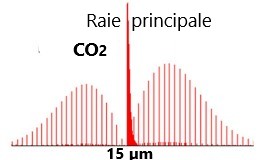
It is often argued that the effect of CO₂ is
saturated, on the grounds that the core of its
absorption band is already opaque. This argument is
physically incomplete.
Although the band center is indeed saturated,
increasing CO₂ produces additional forcing through three
main mechanisms :
1.
broadening of absorption line wings (pressure
broadening,
Doppler effects, collisional
broadening, Fermi resonance);
2. an increase in the effective emission
altitude (optical depth
τ ≈ 1)
3. a decrease in temperature at that altitude. |
 |
The outgoing infrared flux at a given wavelength
can be approximated as :
F_ν
≈ B_ν(T_{τ=1})
where B_v is the Planck function. An increase in emission
altitude implies a lower temperature and therefore a
reduced flux, which lies at the core of radiative
forcing.6. CO₂ and water vapor: distinct roles
Water vapor is the dominant greenhouse gas in
absolute terms, but its concentration is controlled by
temperature via the Clausius–Clapeyron relation. It
therefore acts primarily as a feedback.
CO₂, by contrast, is vertically well mixed by
atmospheric convection and acts as an external forcing.
It is particularly effective in the upper troposphere,
where water vapor concentrations are low. 7.
An irreducible minimum warming
Combining the radiative forcing from CO₂ doubling
with the Planck feedback alone yields a minimum warming :
ΔT_min
= ΔF
/ α₀
≈ 3,7 / 3,2 ≈ 1,1 °C.
This value is not a climate projection but a
lower physical constraint, independent of assumptions
regarding complex feedbacks.
Variation in Earth's temperature as a function of CO2
concentration
According to different calculation methods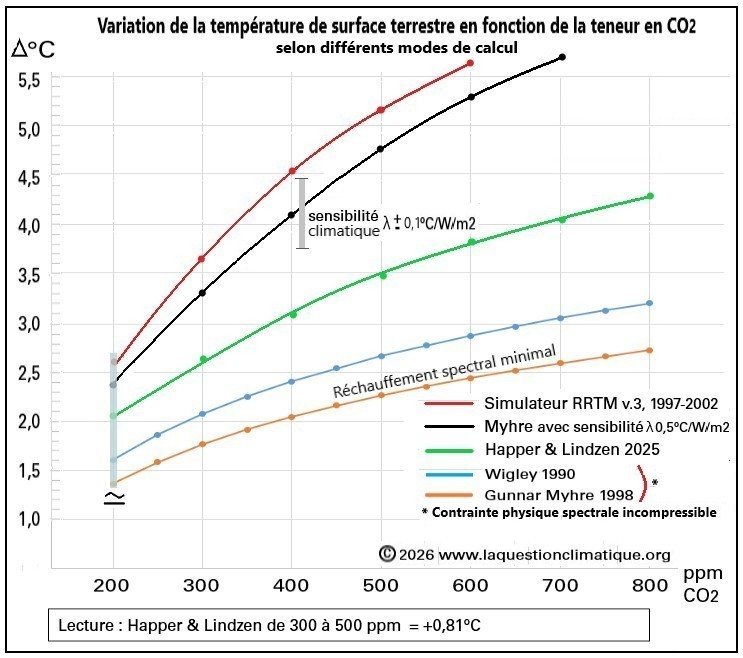
8.
Observations and empirical validation
Satellite observations show both a reduction in
outgoing longwave radiation to space in CO₂ absorption
bands and an increase in downwelling longwave radiation
at the surface. These spectral signatures constitute a
direct validation of radiative forcing.
(Teixeira, J., Wilson, R. C., & Thrastarson, H.
Th., 2024)
9. Factors controlling the effective climate
sensitivity λ
: feedbacks, certainties, and uncertainties
The effective value of
λ results from the
balance between the fundamental radiative constraint
imposed by the Planck feedback and the ensemble of
internal climate feedbacks. These feedbacks modify the
global parameter
α of the energy balance (λ = 1/α) and explain why the
real climate sensitivity must exceed its purely
radiative minimum.
Planck's feedback constitutes the only strictly certain
and incompressible constraint. It imposes α₀
≈ 3,2 W·m⁻²·K⁻¹, soit λ₀ ≈ 0,30 K·(W·m⁻²)⁻¹.
Any realistic scientific discussion about the value
of λ must therefore start from this lower bound.
Water vapor feedback
The
water vapor feedback is the most robust positive
feedback. It follows directly from the
Clausius–Clapeyron relation, according to which
saturation vapor pressure increases by approximately 7 %
per degree Celsius. Assuming roughly constant relative
humidity, warming increases atmospheric water vapor
content, strengthening infrared absorption and reducing
outgoing radiation for a given temperature.
This
feedback is firmly established both theoretically and
observationally and acts throughout the troposphere (Held
& Soden, 2000).
Lapse-rate feedback
The
lapse-rate feedback acts in the opposite direction,
particularly in the tropics, where warming tends to be
amplified aloft relative to the surface. It partially
compensates the water vapor feedback, and the two are
often considered jointly. Their net effect remains
globally positive.
Surface albedo feedback
The
surface albedo feedback associated with reductions in
snow and ice cover is also positive. It is physically
well understood but geographically limited and exerts
only a moderate influence on global climate sensitivity.
Cloud feedbacks
Cloud
feedbacks constitute the main remaining source of
uncertainty. Clouds affect both incoming solar radiation
and outgoing infrared radiation. Observational
constraints and climate models nevertheless converge
toward a weakly positive net cloud feedback, implying a
further reduction of
α and an increase in
λ
(Sherwood, S. C., et al.,2020).
Surface cooling by evaporation
A
frequently
invoked point
concerns the cooling role of water evaporation from the
surface. Evaporation constitutes a significant latent
heat flux (approximately 80 W·m⁻² on global average)
that tends to cool the Earth's surface by transferring
energy to the atmosphere.
In the
laboratory, at constant pressure and saturation, a 1°C
temperature increase leads to an approximately 7%
increase in the saturated vapor pressure, suggesting a
comparable increase in evaporation. However, this
relationship does not directly apply to the real
climate. A theoretical maximum is not always reached.
In
nature, evaporation is limited by several factors: water
availability, atmospheric turbulence, wind speed, and
the maintenance of relative humidity that is sometimes
close to, but always below, saturation. Observations
indicate that the actual increase in global evaporation
with temperature is more moderate (Held & Soden,
2006).
Thus,
although evaporation exerts a local cooling effect on
the surface (soils, oceans, lakes), the energy is
"latent"; it is transferred to higher altitudes and
released only during condensation, contributing to the
overall energy balance. It therefore does not cool the
lower troposphere (conventional altitude 2 m).
Net effect
Combining all feedbacks, observational constraints from
instrumental and paleoclimate data, and climate models
converge toward a likely range of
α between approximately 1.0 and 1.5 W·m⁻²·K⁻¹,
corresponding to
λ between 0.6 and 1.0 K·(W·m⁻²)⁻¹.
For a
doubling of CO₂ (ΔF ≈ 3.7 W·m⁻²), these values imply an equilibrium
climate sensitivity of roughly 2–4 °C. The lower bound
is strongly constrained by radiative physics and
observations, while the upper bound mainly reflects
uncertainties in cloud feedbacks.
No
physically realistic combination of known feedbacks can
reduce
λ to its Planck-only value. Scientific uncertainty
therefore concerns the magnitude of warming, not its
existence or sign.
10.
Analysis of skeptical arguments
Physically serious skeptical arguments concern not the
existence of CO₂ forcing but the effective value of
λ. No robust argument cancels the radiative forcing of
CO₂ itself.
A
frequent conceptual error is the saturation argument,
which implicitly reasons as follows: “If CO₂ already
absorbs everything, it has no further radiative role.”
This would violate Kirchhoff’s law: an opaque layer does
not extinguish flux; it replaces it with its own
emission at its own temperature.
Any
objection not addressing the determination of
λ is therefore invalid.
11. General conclusion
The
radiative forcing of CO₂ is firmly established by
spectroscopy, radiative transfer physics, and
observations. A doubling of CO₂ would impose a minimum
of approximately 1.1 °C of global warming (a lower
physical constraint) and more likely between 2 and
3
°C
due to feedbacks.
The
reason the IPCC continues to cite values up to +4.5 °C
is that it cannot demonstrate that very strong positive
cloud feedbacks are impossible and therefore adopts a
risk-based upper bound rather than an academic mean.
What remains debatable is the media exploitation of this
extreme value by certain activists, sometimes associated
with the IPCC
(politic organisation of United Nations), for purely ideological purposes.
It is
essential to note that the surface warms through global
energetic re-equilibration, not through direct reception
of the forcing. Legitimate scientific debate must focus
on the value of
λ, not on the existence of the undeniable CO₂ effect.
Fundamental references
The following references provide the theoretical and
observational foundations for CO₂ radiative forcing,
climate feedbacks (water vapor, evaporation, clouds),
and constraints on climate sensitivity.
Myhre, G., Highwood, E. J., Shine, K. P., & Stordal, F.
(1998). New estimates of radiative forcing due to well
mixed greenhouse gases. Geophysical Research Letters,
25(14), 2715–2718.
Hansen, J., et al.
(1984). Climate sensitivity: Analysis of feedback
mechanisms. In Climate Processes and Climate
Sensitivity, Geophysical Monograph Series.
Held, I. M., & Soden, B. J.
(2000). Water vapor feedback and global warming. Annual
Review of Energy and the Environment, 25, 441–475.
Held, I. M., & Soden, B. J.
(2006). Robust responses of the hydrological cycle to
global warming. Journal of Climate, 19(21), 5686–5699.
Goody, R., & Yung, Y. L.
(1989). Atmospheric Radiation: Theoretical Basis. Oxford
University Press.
Pierrehumbert, R. T.
(2010). Principles of Planetary Climate. Cambridge
University Press.
Kiehl, J. T., & Trenberth, K. E.
(1997). Earth’s annual global mean energy budget.
Bulletin of the American Meteorological Society, 78(2),
197–208.
Gregory, J. M., et al.
(2004). A new method for diagnosing radiative forcing
and climate sensitivity. Geophysical Research Letters,
31, L03205.
Sherwood, S. C., et al.
(2020). An assessment of Earth’s climate sensitivity
using multiple lines of evidence. Reviews of Geophysics,
58, e2019RG000678.
Teixeira, J., Wilson, R. C., & Thrastarson, H.
Th. (2024). Direct observational evidence from
space of the effect of CO₂ increase on longwave spectral
radiances: the unique role of high-spectral-resolution
measurements. Atmospheric Chemistry and Physics, 24,
6375–6383.
IPCC (GIEC)
(2021). Sixth Assessment Report (AR6), Working Group I –
The Physical Science Basis. Cambridge University Press.

An other article :
Climatic Certainties
|
|